SEVEN-FOLD LUXURIES OF NEOM BABYLON CITY:
- Luxury metals and stones (fine gold, silver, precious stones, pearls). (Rev. 18:12)
- Luxury clothing (fine linens, silks, color dyes). (Rev. 18:12)
- Luxury building materials (precious woods, ivory, brass, iron, marble). (Rev. 18:12)
- Luxury produce (exquisite herbs, fragrances, ointments, wine, oil, flour, wheat). (Rev. 18:13)
- Luxury meat products / animals (beasts, sheep, horses). (Rev. 18:13)
- Luxury cars and transportation (chariots). (Rev. 18:13)
- Human slave trade and sex-trafficking (slaves and souls of men). (Rev. 18:13)
Commentary: This looks like today’s shopping list of the rich and famous, and of the political and financial elite of the world. I believe this covers everything materialistic that is generally valued around the world today (and in the future). There is nothing mundane, routine or common among these delicacies. NEOM BABYLON is built on luxurious living and is the center of worldwide trade of these items and merchandise. These things are literally brought into NEOM BABYLON by the ship loads (Rev. 18:17-19), “For in one hour so great riches is come to nought. And every shipmaster, and all the company in ships, and sailors, and as many as trade by sea, stood afar off.” These items are considered luxurious because they are extremely expensive! (Rev. 18:19, “the great city was made rich by all the ships of the sea by reason of her costliness.”) The people in NEOM BABYLON are extremely materialistic and glorify themselves through their wealth, but are spiritually evil and bankrupt.
Demand for luxury items is so great that merchants of the earth have become wealthy themselves by providing these luxuries Rev. 18:3, “and the merchants of the earth are waxed rich through the abundance of her delicacies.” Both supply (merchants) and demand (people in NEOM BABYLON) worship the created things and not God, the Creator. The worship of and reliance on luxury items plays right into the hands of the mystery religion of Babylon (Mystery Babylon). Keep in mind that all these players (merchants and NEOM BABYLON citizens), all have the mark of MbS and his system. They are allowed to sell and buy through the complicity and authority of the antichrist’s economic machinations via having the mark. Hypothetically speaking, I wouldn’t be surprised if the wealthy in NEOM BABYLON view the Mohammed bin Salman’s mark as a luxury brand symbol or something equivalent. Sad, very sad (understatement).
Interestingly, there is a parallel condemnation of wealth and materialism regarding the church of Laodicea (Rev. 3:14-22). During the time when John received the Revelation of Jesus Christ, Laodicea was a leading banking center, and known for manufacturing garments made from a soft, black wool. Additionally, Laodicea was also home to a famous medical school that specialized in the treatment of eye diseases. The city had a lot going for it economically. The Laodicea church also benefited financially from the surrounding strong economy. The city was so strong financially, that in AD 60 when it was destroyed by an earthquake, Laodicea paid for its own reconstruction instead of asking Rome for rebuilding funds.
As a result of the Laodicean church’s self-sufficiency and affluence, they received a strong rebuke from Jesus. The church considered itself wealthy and self-sufficient, instead, Jesus viewed this church very differently. He saw this church as “wretched, pitiful, poor, blind and naked”, using metaphors from the local economy that surrounded the church. “Because thou sayest, I am rich, and increased with goods, and have need of nothing: and knowest not that thou art wretched, and miserable, and poor, and blind, and naked.” (Rev. 3:17)
While the church thought it had everything, it had nothing. They confused material prosperity and comfort with spiritual health and security. The Bible teaches that the rich (and very rich, by today’s standards) are often tempted to rely upon themselves, while the poor often turn to the Lord for help. Jesus challenges his people to trust in him rather than in material possessions, and to use things to meet the needs of others (Deut. 8:10-14; Prov. 30:8-9; Matt. 6:19-24; Luke 12:13-21; 1 Tim. 6:6-10, 17-19). Physical wealth and comfort can foster spiritual complacency and self-reliance. Affluence tempts us to forget God. The message to the church of Laodicea illustrates the power of forgetting God, due to materialistic affluence.
From an economic point of view, the parallel between NEOM BABYLON and Laodicea is staggering. The rebuke that Jesus gave the church of Laodicea is generally considered to be one of the stronger (est) rebukes given to the five churches who were in need of correction. Keep in mind that Jesus’ rebuke was to those members in his own house (church). NEOM BABYLON has the same evil symptoms, but on steroids! Citizens of Babylon and worshippers of Mystery Babylon are swimming in luxury, wealth, materialism and self-sufficiency. Greed is rampant. They are not members of Jesus’ church and they do not acknowledge or worship the Creator who made the material wealth they worship and enjoy.
Revelation 18:7 indicates, “How much she hath glorified herself, and lived deliciously.” God is not remotely on their spending or spiritual radar. They are utterly deceived by their materialism and love of luxury and “delicious living”. Since Jesus strongly rebuked the Laodicean church members, how much more so will God pour out His wrath on NEOM Babylon, who openly rejects him for the love of wealth? The Laodicean Church received rebuke from Jesus, NEOM BABYLON will receive total destruction by God. This should be a message to today’s churches who preach the prosperity gospel. God is not against a person being prosperous, however, he is against the amount of prosperity that fosters complacency and self-sufficiency, or to the point of fostering wealth worship (greed) at the expense of forgetting one’s relationship with God and Jesus Christ.
The (5) Wealthy and the God of (5) Luxury, Money, Pleasure, Self-Indulgence and Materialism
Saudi Arabia: High-net-worth Muslims eye luxury homes in holy cities, report finds. Five (5) years and $5.5 (5) million for ‘average’ home budget price.
The kingdom’s real estate market could be turbocharged by demand for luxury homes tied to brand names like Versace and Bulgari, according to real estate consultancy firm Knight Frank
By Sean Mathews Published date: 1 May 2024 21:24 BST | Last update: 3 hours 50 mins ago Middle East Eye
Saudi Arabia’s drive to attract expats and boost its real estate market could be turbocharged by a largely untapped demographic in the global south: rich Muslims eyeing homes in Islam’s two holiest cities.
According to a report published by real estate consultancy firm Knight Frank, despite western media focusing much of its attention on the kingdom’s drive to boost luxury beach resort tourism and legalise alcohol, demand for glitzy real estate in Saudi Arabia has surged among Muslim high-net-worth individuals (HNWI). “79 percent of our Muslim HNWI respondents would like to make their residential property purchase in one of the holy cities within the next five (5) years,” Knight Frank said, adding that the average budget for potential buyers in Mecca is $5.5m while buyers in Medina have an average budget of $4.6m.
Knight Frank said that Saudi Arabia is sitting on an untapped luxury real estate market because average prices for villas in the two cities are around $600,000, and that the market could absorb “substantially higher levels of luxury housing”.
“The appetite from international HNYWI for luxury homes in the Holy Cities shines a light on a new area of opportunity for developers and investors,” the authors said. The report polled 506 HNWI, with 63 percent of respondents coming from Indonesia, Malaysia and Turkey. Other countries included Algeria; Iraq; Iran; Pakistan; India; Malaysia; and Singapore. Among the respondents, 60 percent said their main motive for buying a home in Saudi Arabia was for investment purposes, while 45 percent cited cultural and religious reasons. Most Indonesians, Pakistanis and Turks preferred the holy city of Mecca, while the majority of Algerians preferred the Saudi capital of Riyadh. The small number of Iranian respondents are eyeing homes in the Red Sea coastal city of Jeddah. Muslim buyers from Indonesia, India and Pakistan were the most interested in making a purchase.
Brand names
Earlier this year, Saudi Arabia unveiled a new premium residency visa that underlines how it is trying to capture the wealthiest buyers. It offers residency to buyers of real estate worth at least $1.06m, making it one of the priciest in the world. A big chunk of Muslims seeking luxury homes in Islam’s two holiest cities would also like to see brand-name residencies of the kind that have mushroomed in the UAE. Developers in Dubai have cashed in catering to wealthy buyers who want luxury real estate tied to a brand name, like the Four Seasons, Bulgari, and Armani. Almost a third of wealthy Muslim buyers eyeing homes in Mecca want real estate with brand names like Versace, Ritz Carlton and Bulgari. “We are already seeing significant investment and expansion branded residential offerings around the region, with Saudi Arabia likely to be one of the most exciting new residential markets,” the report said.
Saudi home prices soar
Saudi Arabia has experienced a housing boom under Crown Prince Mohammed bin Salman, who has set a target of 70 percent home ownership among Saudis as part of his plans to diversify and modernise the oil-rich kingdom’s economy. The public investment fund, which is chaired by the crown prince, has been one of the main drivers of this diversification by flooding the market with extra liquidity so banks issue more loans.
The effort is reshaping Saudi Arabia’s housing market, with mortgage financing now representing 23.5 percent of Saudi banks’ total credit allocation in 2023, compared to just 12.8 percent in 2019. Home prices in Riyadh have shot up to record levels, with apartments and villas now 26 percent and 21 percent, respectively, above their 2016 peaks, according to Knight Frank. That has led some to warn about a real estate bubble in the desert kingdom, with home sales now slumping. Residential transactions, which made up roughly 59 percent of all real estate deals by total value, fell 16 percent to just under 150,000 sales between January and November 2023, the report noted.
NEOM BABYLON Being on the Red Sea
- A new vibrant destination on the coast of the Red Sea and the Gulf of Aqaba.
- Access to the Mediterranean Sea.
- The city will sit close to the maritime trade routes that use the Suez Canal.
- 50% of NEOM Babylon’s perimeter is coastline (either on the Red Sea or Gulf of Aqaba).
N EOM/Babylon city is within easy eyesight and access of sea(s) and maritime trade routes.
“The merchants of these things, which were made rich by her, shall stand afar off for the fear of her torment, weeping and wailing. And saying, Alas that great city, that was clothed in fine linen, and purple, and scarlet, and decked with gold, and precious stones, and pearls! For in one hour so great riches is come to nought. And every shipmaster, and all the company in ships, and sailors, and as many as trade by sea, stood afar off, And cried when they saw the smoke of her burning, saying, What city is like unto this great city! And they cast dust on their heads, and cried, weeping and wailing, saying, Alas, alas that great city, wherein were made rich all that had ships in the sea by reason of her costliness! For in one hour is she made desolate. Rejoice over her, thou heaven, and ye holy apostles and prophets; for God hath avenged you on her. And a mighty angel took up a stone like a great millstone, and cast it into the sea, saying, Thus with violence shall that great city Babylon be thrown down, and shall be found no more at all.” (Rev. 18:15-21).
Mega-yachts versus sailboats: Saudi Arabia’s quest to conquer Red Sea tourism
Western sailors are coming away with a taste of Saudi culture and hospitality but also coping with high prices, pesky princes and a security state
By Sean Mathews Middle East Eye
First, the mega-yachts came to Saudi Arabia.
It was 2021, and a discreet message had been sent out to the sailing world’s most exclusive club: the coast of a yet-to-be-constructed, futuristic $500bn mega-city on the Red Sea was open for a sneak peek.
“More than 10 mega-yachts a day were going through the Suez Canal, all coming from the Mediterranean to Neom,” Ehab Soukar, owner of sailing agency Prince of the Red Sea in Port Suez, Egypt, told Middle East Eye. “I arranged transit for Brits, Swedes and Americans.”
Since then, Saudi Arabia has broadened efforts to promote its 2,000km coastline for leisure travel. In October, the Jeddah Yacht Club began offering cut-rate prices to sailing YouTubers willing to stop at its new state-of-the-art marina, sources told MEE.
The invite enticed Keith Whitaker, who was in the Red Sea documenting his family’s sailing adventures to his 550,000 subscribers on his channel Sailing Zatara. “Saudi Arabia has the potential to be a great cruising ground,” Whitaker told MEE.
Ken Powers, who has the channel Sailing Aquarius Around The World, followed. “Saudi Arabia really wants people to come to the Red Sea. They will support anybody with a YouTube channel.”
The campaign is paying off.
Watching Whitaker’s Youtube videos convinced Frank Weiand to visit. He spoke to MEE from the Greek island of Crete, the final leg on his journey to the oil-rich kingdom. Of course, Saudi Arabia’s sailing industry is so nascent that the Jeddah Yacht Club and marina appears in the middle of the Red Sea on Weiand’s new GPS system.
“They have some kinks to work out,” he told MEE.
‘Saudi Arabia wants mega-yachters’
Crown Prince Mohammed Bin Salman is leveraging oil revenue to diversify his kingdom’s economy with investments in tourism and entertainment. Saudi Arabia recruited football star Cristiano Ronaldo and this month a Saudi-backed Golf league cut a deal with the PGA. But the Red Sea lies at the epicentre of Saudi Arabia’s ambitions.
While mega-projects like the 170km Line city are years away from completion, and still dogged by scepticism, yachting is underway.
Western sailors are coming away with a taste of the kingdom’s culture and traditional hospitality, but they are also coping with high prices, pesky princes and a security state.
Veteran Australian sailor Wayne Sillick checked into the Jeddah Yacht Club this spring. He told MEE he paid an “outstandingly high” price of $2,100 for entry and exit to the marina, along with visas and permits.
Agent fees to coordinate check-in and arrange for fuel and supplies ran about 500 percent higher than anywhere else he has paid while circumnavigating the globe.
MEE reviewed one bill from a Saudi agent posted in the private Facebook group ‘Red Sea Passage’ for $4,945 that included entry and exit visas for four people. Members of the group expressed shock at the price. Since Saudi Arabia opened for tourists in 2019, visas are available online for $123 per person.
“The Saudis want mega-yachters with money, they aren’t geared to servicing middle class yachties,” said Sillick.
The Saudi port city of Jeddah, where an upgraded marina was unveiled in 2021 to host yachts for the Formula 1 Grande Prix, is the kingdom’s main sailing hub, but the centre of gravity will shift north when the Red Sea Island Project and Neom open. Prices there are expected to be even higher with a luxury marina company set to take over management.
The seaside resort of Sindalah, which will have an 86 berth marina, is slated to be the first Neom project to open. Its website advertises proximity to pricey European yachting spots like Capri, Monaco and Porto Montenegro. It’s being billed as a natural winter stopover from the Mediterranean.
“High net worth and ultra-high net worth individuals and young people with the potential for future wealth generation” is the western demographic Saudi Arabia is targeting, Robert Mogielnicki, a senior resident fellow with the Arab Gulf States Institute, told MEE.
https://www.middleeasteye.net/sites/default/files/Neom%20yachting-2.jpg
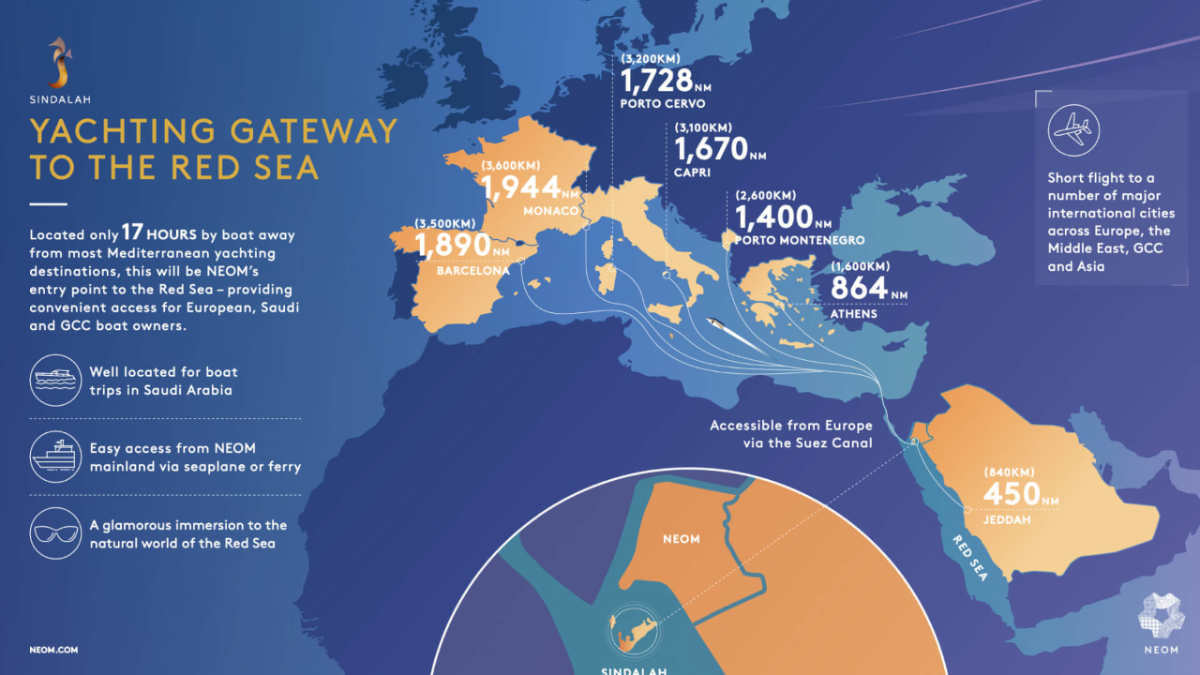
Saudi Arabia is promoting Sindalah’s proximity to European yachting destinations (Neom graphic)
But thousands of dollars buys a lot less sailing around Saudi Arabia than it does in Mediterranean destinations like Greece, Italy or Turkey where boats are free to drop anchor as they please, and cruising fees run a couple hundred euros a month on average.
‘MBS cracks the whip’
Despite a push to lure sailors, the pastime remains bureaucratic and tightly regulated. Sailors have to submit the spots where they want to drop anchor on a portal called Ebhar for pre-approval by Saudi authorities. Boats are also required to check in and out of the country from the same port of origin, making it difficult to bounce around.
“You can’t just find a nice hidden beach and swim. The Saudis don’t understand how much freedom western sailors want,” Sillick added.
“Every single little place where you can seek shelter has a coastguard stationed there, and bloody hell, the equipment those guys have,” Per Kjellqvist, a sailor based on the Greek island of Rhodes told MEE, describing his trip.
“By nature, sailors want to explore things. We are the Saudi coastguard’s worst nightmare,” added Sillick
Much of Saudi Arabia’s coastline is sealed off because of ongoing construction on mega-projects, but that’s not the whole story.
“All the best places to cruise from a yachting perspective, the royal family has built private installations on them and you aren’t allowed to go 20 miles (32km) near them,” Whitaker from Sailing Zatara told MEE. “These guys know what prime property means and have taken some of the best spots.”
Kjellqvist tried to sail to Jabal Hassan Island near the city of Umluj but was told by his agent to stay away because a member of the royal family was yachting there.
“It’s a turn-off,” he told MEE. “In the Mediterranean nobody cares who you are, you have sailboats next to mega-yachts.”
https://www.middleeasteye.net/sites/default/files/Saudi%20Coast-3.png
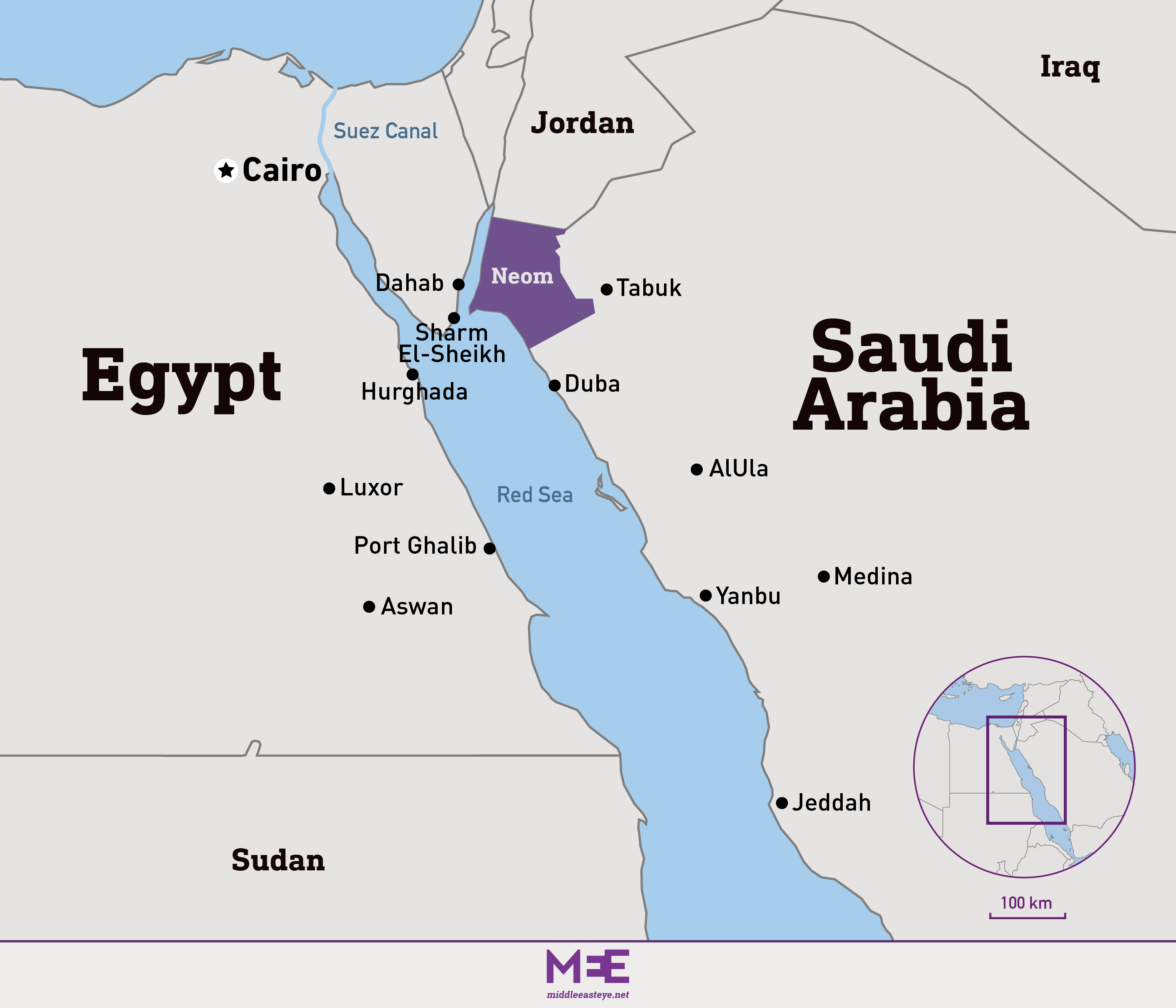
Saudi Arabia is already pinching sailors away from Egypt, but its ambitions are much bigger. By 2030, the kingdom aims to have 8,000 new hotel rooms along its Red Sea coast (MEE)
Crown Prince Mohammed Bin Salman is reported to have a taste for luxury coastal life. He owns a 439-foot (139 metres) yacht with two helipads and a nightclub. As a young defence minister, he airlifted models from Russia and Brazil to an island party in the Maldives.
The Saudi tourism industry clearly has a penchant for mega-yachts over everyday sailboats, experts and sailors say.
One reason is that higher profit margins can be had in the luxury market, but the crown prince also hopes they will help him make a “bigger splash” on the world stage as he unveils Vision 2030, Steffen Hertog, a Gulf expert and associate professor in comparative politics at the London School of Economics, told MEE.
“It’s probably also just an affinity to royal taste,” he added.
“MBS [Mohammed Bin Salman] could certainly crack the whip and make large swathes of the Saudi coast available to sailors,” Hertog added. “But I don’t think this is an issue if visitors want resort-style tourism and guided tours. There is a rich, and not very adventurous clientele for this.”
Mohammed Bin Salman has overseen a severe crackdown on dissent at home and a US intelligence report determined he probably ordered the 2018 killing of Saudi journalist Jamal Khashoggi. But his once-in-a-generation social reforms have been welcomed by many Saudis, particularly young people.
The 37-year-old crown prince stripped the religious police of their powers, allowed women to drive and permitted gender-mixing. Saudi Arabia was the top performing G-20 economy last year. The crown prince also tightened the purse strings on profligate royal family members.
‘Jeddah awash with booze’
But the influx of sailors is shaping up to be an early test of how far Saudi Arabia is willing to take its social reforms.
Rumours are swirling that the kingdom, home to the two holiest sites in Islam, is preparing to allow the sale of alcohol in resorts along the Red Sea. Sailors coming from abroad can have alcohol on their boat, but are not allowed to consume it. In practice, however, visitors tell MEE that enforcement is lax.
“Jeddah was awash with booze. I can tell you we enjoyed our alcohol there,” Sillick, who sailed into the kingdom with his wife just as the Grande Prix was wrapping up, told MEE.
“The Saudis turned a blind eye.”
For others, Saudi Arabia’s subdued atmosphere is itself a draw.
Powers described his stay in Jeddah as “refreshing” because he has grown tired of the drinking culture in western ports. “The sailing community drinks way too much. If you want a drink in Saudi Arabia you can have it, but I didn’t feel forced to drink.”
The debate over alcohol underlines the challenge Saudi Arabia faces as it looks to pinch high-spending western tourists and compete with established Gulf vacation spots like the UAE and Oman, where rules on alcohol and cohabitation are more permissive.
One advantage is that on the Red Sea at least, Saudi Arabia faces little competition.
https://www.middleeasteye.net/sites/default/files/sindalah_resort%20.jpg

The Jordanian port of Aqaba and Israel’s Eilat lie farther north, making them separate destinations. The only neighbouring country offering an alternative to Saudi Arabia is Egypt.
But corruption, and Egyptian authorities’ aggressiveness, have scared sailors away.
“I didn’t feel safe leaving my boat in Egypt. There is no accountability there,” Powers said.
The Red Sea Passage Facebook group is awash with horror stories about stopping in Egypt. “The place is a hellhole for sailors,” Paul Hullenaar, an Austrian yachter, told MEE.
“In Egypt, it’s all about ‘baksheesh’. I was happy to leave Egypt for Saudi Arabia,” Hullenaar said, using the Arabic word that loosely translates to bribe or tip.
And the cost to sail in Egypt has been rising as Cairo looks to make up for a foreign currency shortfall.
Soukar, the Port Suez agent, told MEE that prices quadrupled in 2022. He estimates a cost of $1,500 to enter and exit Egypt’s Port Ghalib or Hurghada after fees and permits, compared to about $2,000 in Saudi Arabia, which has much newer facilities.
“In Egypt, we have a military government that’s just trying to get money. They are thinking short term,” Soukar told MEE.
Soukar has worked with 66 private boats transiting south through the Suez Canal this year. All of them have changed their stopover from Egypt’s Port Ghalib to either Aqaba or Saudi Arabia.
“Saudi Arabia is just starting off,” he said. “With time it will be more popular than Egypt for sure.”
‘From sailboats to motorcycles’
But the kingdom wants big numbers.
By 2030, Saudi Arabia plans to have built 50 resorts with 8,000 hotel rooms along the Red Sea. Neom’s flagship resort Sindalah is advertising kayaking, kite-surfing and snorkelling. Swanky hotels like the Ritz Carlton and the St. Regis are going up.
Mogielnicki said the early sailing arrivals have a promotional benefit. “[They] lend very well to social media glitz and glamour,” he told MEE. “Sailing advances the perception that Saudi government officials want to promote of a changing country.”
Critics have accused Saudi Arabia of investing in sports and entertainment to gloss over its poor human rights record. MEE spoke with more than half a dozen sailors who visited the kingdom for this article. Many actually cited critical western media coverage of Saudi Arabia as inspiring them to visit.
“As Americans, we constantly hear all this bad stuff about MBS. But Saudi Arabia is nothing like how it’s portrayed in the media. Saudi Arabia is nice,” Powers said.
“I don’t feel comfortable spending money in countries that don’t respect human rights,” Weiand, who is setting sail from Crete to Saudi Arabia, said. “On the other hand, if you only hear about Saudi Arabia from the media, are you informed?” he asked.
“I want to make my own judgement. I see what’s going on in Jeddah and I think they are trying to improve for the better,” he said.
And the high prices and pesky princes Kjellqvist ran across aren’t deterring him from visiting again. “I loved the Saudi people. They were so welcoming.”
He is already scoping out his next trip, this time inland, crossing the country by motorcycle.
This article is available in French on Middle East Eye French edition.
*******
Night Watchman
Paul Rolland
Night Watchman
Make Your (7) Decision for Christ NOW!!!!!!! Time is Up!!!!!!!
Jesus Christ’s Offer of Salvation:
The ABCs (7) of Salvation through Jesus Christ (the Lamb)
- (7) Admit/Acknowledge/Accept that you are sinner. Ask (7) God’s forgiveness and repent of your sins.
. . . “For all have sinned, and come short of the glory of God.” (Romans 3:23).
. . . “As it is written, There is none righteous, no, not one.” (Romans 3:10).
. . . “If we say that we have no sin, we deceive ourselves, and the truth is not in us.” (1 John 1:8).
B. Believe Jesus is Lord. Believe that (7) Jesus Christ is who He claimed to (7) be; that He was both fully God (7) and fully man and that we are (7) saved through His death, burial, and resurrection. (7) Put your trust in Him as your (7) only hope of salvation. Become a son (7) or daughter of God by receiving Christ. (7777777) 7×7
. . . “That whosoever believeth in him should not perish, but have eternal life. For God so loved the world, that he gave his only begotten Son, that whosoever believeth in him should not perish, but have everlasting life. For God sent not his son into the world to condemn the world; but that the world through him might be saved. (John 3:15-17). For whosoever shall call upon the name of the Lord shall be saved.” (Romans 10:13).
C. Call upon His name, Confess (7) with your heart and with your lips (7) that Jesus is your Lord and Savior.
. . . “That if thou shalt confess with thy mouth the Lord Jesus, and shalt believe in thine heart that God hath raised him from the dead, thou shalt be saved. For with the heart man believeth unto righteousness; and with the mouth confession is made unto salvation.” (Romans 10:9-10).
. . . “If we say that we have no sin, we deceive ourselves, and the truth is not in us. If we confess our sins, he is faithful and just to forgive us our sins, and to cleanse us from all unrighteousness. If we say that we have not sinned, we make him a liar, and his word is not in us.” (John 1:8-10).
. . . “And he is the propitiation for our sins: and not for ours only, but also for the sins of the whole world. (John 2:2).
Categories: 'Last' 'Latter' 'End of' Days, Anti-Christ, Antichrist, Antichrist, Babylon City of Tribulation, Bottomless Pit, City on 7 Scarlet Purple Mountains, Demonic Activity, Doctrines of Devils, Evil Prince Confirmer of False Peace, False Idols, Fig Tree Generation, FIRST Horseman Apocalypse, Four Horsemen of the Apocalypse, Government Repression Control, Great Angel of Prophecy, Great City of Mystery Relgion, GREAT WARNING!!!, Last Nimrod, Mahdi, Man by Satan, Man of Lawlessness, MbS Beast Prince Antichrist, Neom Babylon, Perilous Times, Prophetic Timelines, Second Coming of Christ, Seven (7) Bowls, Seven (7) Seals, Six (6) Six (6) Six (6) - 666, Son of Perdition, The Assyrian, The Final Generation, The GREAT CITY, The GREAT WHORE, The Mother of Harlots, The Wicked One, Those Left Behind, Tribulation Babylon City, VISION 2030, White Throne Judgement